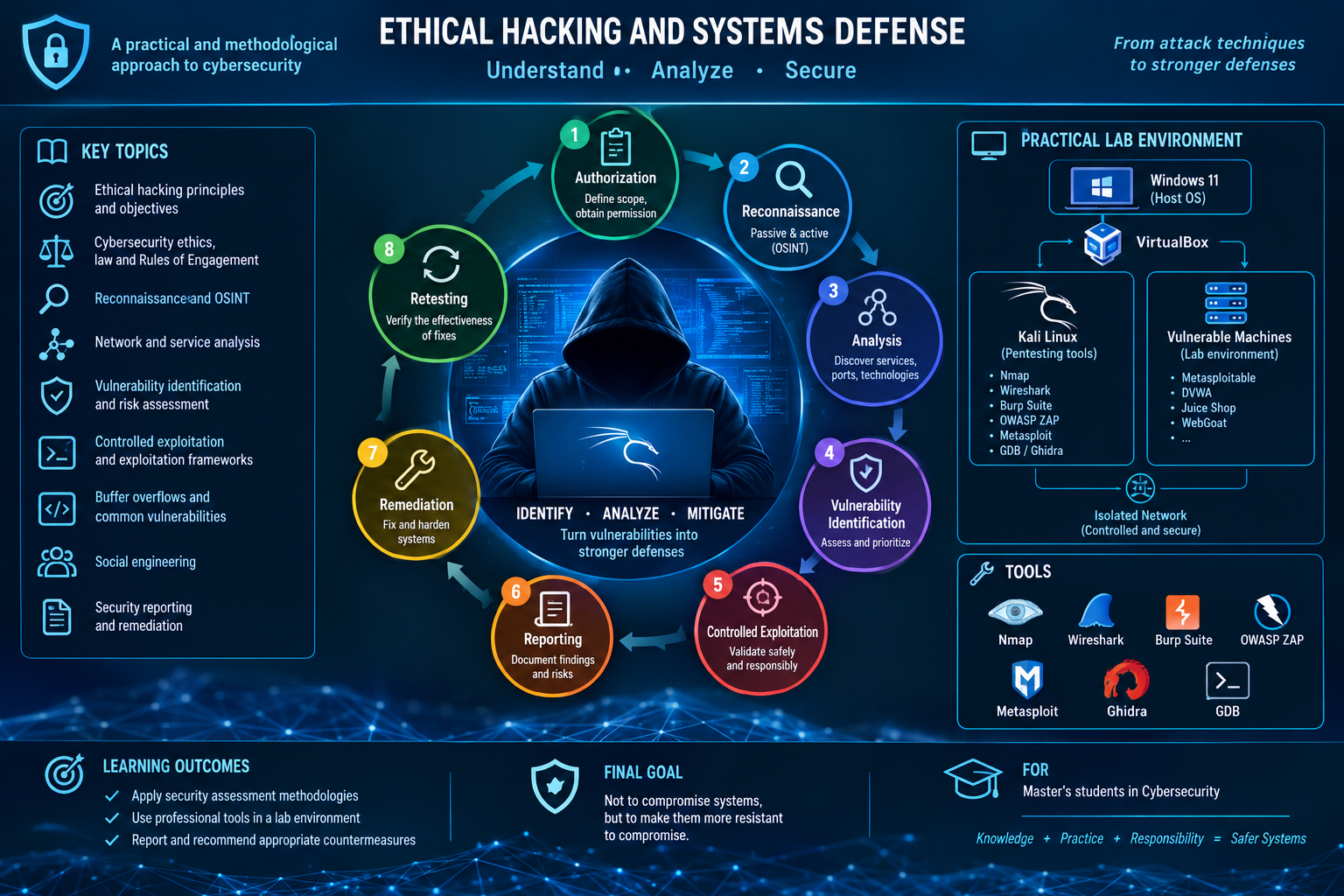
Ethical Hacking and Systems Defense is a practical and methodological cybersecurity course that introduces students to the principles, techniques, and tools used to identify, analyze, and mitigate security vulnerabilities in information systems. The course covers the complete security assessment process, including ethical hacking principles, cybersecurity ethics, Rules of Engagement, reconnaissance and OSINT, network and service analysis, vulnerability identification, controlled exploitation, buffer overflow concepts, exploitation frameworks, and social engineering. Particular emphasis is placed on the defensive purpose of ethical hacking, responsible vulnerability assessment, risk analysis, professional security reporting, and remediation. Through controlled laboratory environments using virtual machines and intentionally vulnerable systems, students develop practical skills with common cybersecurity tools while learning to operate within clearly defined legal, ethical, and technical boundaries. The course ultimately aims to develop a professional, risk-oriented mindset enabling students to assess system weaknesses and contribute effectively to the improvement of organizational cybersecurity.
- معلم: Sofiane BENABBES

This module provides a cross-disciplinary approach to wireless communication security, spanning legacy cellular infrastructures (GPRS, WiMAX), next-generation networks, and decentralized architectures (ad hoc networks, sensor networks). It analyzes the transition toward all-IP architectures through the IMS core network, while detailing the critical mechanisms of authentication, encryption, and key management tailored to the constraints of mobility and limited resources. Finally, the course secures the end-to-end communication chain by addressing mobile execution environments (Android, Java Card) and the integrity of downloaded applications, enabling students to master data protection from the user terminal to the operator’s core network.
- معلم: Sofiane BENABBES
Ethics and Deontology of Computer Science and IT
- معلم: GAHMOUSSE ABDELLATIF
General Objectives
This course material serves as an introductory guide to software modeling and design. It aims to equip students with the skills to develop reusable and scalable solutions while familiarizing them with the principles of modeling languages. The guide also emphasizes the practical application of UML (Unified Modeling Language) to leverage its full potential.Upon completing this material, students will be able to:
- Understand the fundamental concepts of object-oriented programming and data modeling.
- The core principles of the object-oriented design process using the key UML diagrams and techniques.
- معلم: GATTAL ABDELJALIL
Initier l'étudiant aux principes et méthodologies de l'administration des réseaux
informatiques. Lui présenter les outils de gestion de réseau en le sensibilisant aux aspects
d'organisation, de performance et de sécurité
- معلم: ABBAS FAYCEL
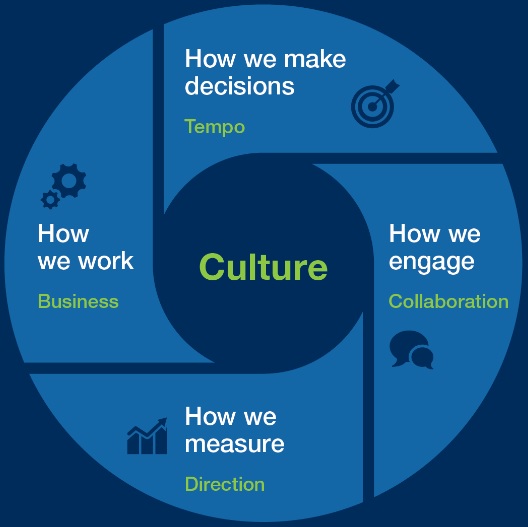
Ce module permet à l'étudiant d'apprendre et comprendre le fonctionnement des entreprises et des organisations à travers leur environnement, leurs structures et leurs principales fonctions.
- معلم: GAHMOUSSE ABDELLATIF
Ce cours a pour objectif de présenter, de manière unifiée, les principales architectures des réseaux téléinformatiques et télécommunications ainsi que les outils mathématiques pour leur dimensionnement et l'évaluation de leurs performances. En partant des algorithmes et fonctions de communications, il analyse l'architecture des principaux réseaux filaires et sans-fils existants (réseaux locaux tels qu'Ethernet Commuté, Token Ring, les VLAN et WLAN, réseau longue distance ATM, frame Relay, ...)
- معلم: ABBAS FAYCEL
Ce support de cours est un guide d’initiation à la modélisation et à la conception logicielle et lui permettre d’élaborer des solutions réutilisables et extensibles, le familiariser avec un langage de modélisation. Ce guide vous permettra de tirer parti de fonctionnalités portées par UML.
L’objectif de ce support est de permettre aux étudiants :
· Apprendre les notions de base de l’objet et les bases des données orientée objet.
· Apprendre le processus de conception orientée de base des différents principaux langages UML.
- معلم: GATTAL ABDELJALIL